Water coolers
Are Water Fountains Safe to Drink From? Why Offices Are Upgrading to Modern Hydration

Authored by
Jeff Price
Jeff is the Vice President of Product for Culligan Quench. He has expertise in product strategy, performance evaluation, and go-to-market execution for water filtration, ice, sparkling, and coffee solutions.
Key Takeaways
Workplaces are upgrading their water systems to more hygienic, efficient options.
Public trust in tap water and evolving workplace hygiene standards are driving office and facilities managers to replace traditional drinking fountains with modern filtered alternatives.
- Hygiene considerations: Fountain designs vary, but traditional shared-spout models can create additional contact points. Touchless bottleless coolers can reduce shared contact.
- Contamination concerns: EPA drinking water standards for PFAS and lead risks from aging plumbing or fixtures have put greater focus on filtration and water quality in institutional settings.
- Cost considerations: Drinking fountain costs vary widely, and some units and installations can exceed $5,000 before ongoing maintenance. Culligan Quench’s rental model eliminates upfront capex and bundles service.
- The modern replacement: Bottleless point-of-use coolers offer plumbed-in convenience and filtration configurations that may include carbon filtration, RO, UV-C treatment and electrolyte remineralization. Certifications vary by system and treatment type and may include NSF/ANSI 42, NSF/ANSI 53, NSF/ANSI 58 and NSF/ANSI 55. They can also deliver up to 80% savings vs. bottled water delivery.
- Facilities-driven trend: This isn’t just consumer preference, as corporate offices, university campuses, government buildings and health care facilities are actively decommissioning fountains in favor of certified, touchless hydration infrastructure.
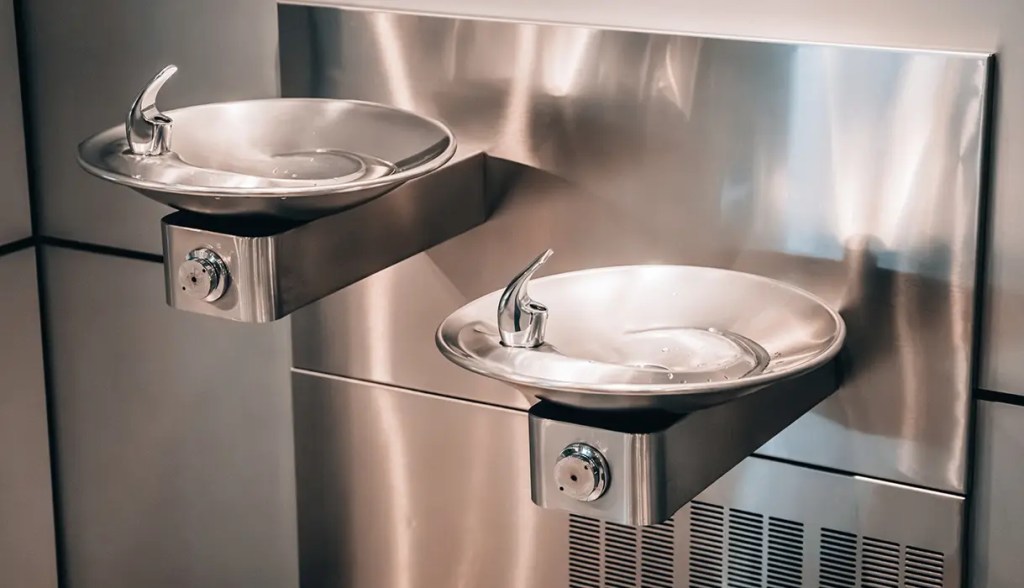
Traditional drinking fountains are being decommissioned across offices, campuses and government buildings. Rising hygiene concerns, PFAS and lead contamination risks and post-COVID expectations for touchless hydration have accelerated the shift. Bottleless coolers have emerged as the infrastructure-grade replacement, delivering multi-stage, filtered, touchless, certified water quality without the maintenance burden or upfront plumbing cost of a wall-mounted fountain.
Hygiene concerns, PFAS and lead contamination risk, and the availability of superior hydration alternatives are prompting many workplaces to reconsider or decommission their drinking fountains. Searches for “are water fountains safe to drink from?” have reached an all-time high, making now the perfect time to replace your tap or bottled water with certified Quench bottleless coolers, which use multi-stage filtration to reduce contaminants and improve taste.
Why are offices replacing drinking fountains?
In 2024, Americans consumed 16.2 billion gallons of bottled water. Nearly 70% of people surveyed reported that they would turn to other packaged drinks, not tap water, if bottled water wasn’t available. This reflects the growing distrust in tap water, which often looks cloudy or tastes like chlorine and other contaminants.
The U.S. EPA has established drinking water standards for six PFAS (per- and polyfluoroalkyl substances). PFAS are commonly known as “forever chemicals” because many persist in the environment for long periods. Long-term exposure to certain PFAS has been associated with adverse health effects, making their reduction in drinking water an important public health objective.
Are water fountains filtered?
So, do drinking fountains filter water? Some do. Traditional wall-mounted fountains may use municipal tap water with no additional treatment, while newer models can include filtration. Culligan Quench bottleless systems offer filtration options including carbon and reverse osmosis (RO), with select systems also using UV-C treatment and electrolyte remineralization.
Depending on the filtration and treatment configuration, select systems are certified to standards including NSF/ANSI 42, NSF/ANSI 53, NSF/ANSI 58 and NSF/ANSI 55:
- NSF/ANSI 42 and 53: NSF/ANSI 42 addresses aesthetic effects and includes material-safety and structural-integrity requirements, while NSF/ANSI 53 covers reduction claims for contaminants with health effects.
- NSF/ANSI 58: Applies to reverse osmosis drinking water treatment systems.
- NSF/ANSI 55 Class A: Establishes performance and construction requirements for ultraviolet microbiological water treatment systems. Class A certified systems are intended to disinfect drinking water by providing a UV dose capable of inactivating bacteria, viruses and protozoan microorganisms under the conditions specified in the standard.
Are drinking fountains sanitary?
The COVID-19 pandemic heightened attention to public drinking fountain safety. Traditional fountains may involve shared contact points, while newer designs can include touchless features. Lead is another concern, particularly in older buildings, where water can pick up lead from plumbing or fountain components.
Researchers have found Staphylococcus aureus, Salmonella spp. and other harmful organisms in water taken from drinking fountains, prompting businesses, nonprofit organizations and government agencies to adopt touchless solutions. Culligan Quench combines touchless dispensing with antimicrobial surfaces, making it easier to promote workplace hydration.
The real cost of a drinking fountain vs. a bottleless water cooler
| Cost Factor | Traditional Drinking Fountain | Culligan Quench Bottleless Cooler |
| Initial Install | Varies; some projects can exceed $5,000 | Install fee starts a $199 — rental model available |
| Annual Maintenance | $200–$800+ (parts, labor) | Included in service plan |
| Filtration | Varies by model; filtration may be included | Carbon or RO; select models add UV-C + remineralization |
| Hygiene | Shared-spout or touchless models | Touchless sensor dispensing, antimicrobial surfaces |
| Certifications | NSF/ANSI 61 | NSF/ANSI 42, 53, 58 & 55 (model dependent) |
| Lead / PFAS Risk | Possible (aging infrastructure) | Reduced via NSF/ANSI 53-certified filtration |
“Are drinking fountains safe?” isn’t the only question you need to ask. You should also consider the cost of installing and maintaining a fountain versus using a bottleless water cooler.
Costs vary by unit and installation requirements, and some drinking fountain projects can exceed $5,000, especially when significant plumbing or outdoor work is involved. Ongoing maintenance adds to the total cost. Culligan Quench rental eliminates the capital expense of purchasing a fountain, and our service plan covers routine maintenance.
As a result, switching to a bottleless system can be up to 80% less expensive than signing up for bottled water delivery. Use our ROI calculator to see your savings.
What replaced the drinking fountain in modern workplaces?
Water fountains are far from the most convenient option. Bottleless point-of-use coolers connect to your building’s existing water supply line, provide a touchless user experience and come with upgraded filtration systems, making it easy to certify water quality.
Bottleless coolers are ideal for:
- Corporate offices
- University campuses
- Government buildings
- First responder stations
- Health care facilities
See your cost savingsUse our cost calculator to get a personalized savings estimate.
Try now
How Culligan Quench bottleless coolers outperform tap and bottled water
Culligan Quench bottleless coolers offer several advantages over tap and bottled water. Depending on the model and filtration configuration, systems can use carbon or reverse osmosis to reduce a range of contaminants, including lead, cysts, arsenic and PFAS, as well as chlorine taste and odor. If you’re comparing bottleless vs. bottled water, a bottleless system eliminates plastic waste and delivery costs.
Culligan Quench systems also outperform standard drinking fountains. With a bottleless system, you get several types of filtration, a touchless user experience and quality that meets several NSF/ANSI standards. Select RO configurations add electrolytes back to the water for improved taste.
Upgrade from fountain water. Go bottleless
How to replace a drinking fountain in my office or building
Follow these steps to replace a standard drinking fountain with a Culligan Quench bottleless system:
- Assess location and water line access.
- Choose a Culligan Quench model based on space constraints.
- Schedule installation. Culligan Quench handles the plumbing tie-in, maximizing convenience.
Modern hydration infrastructure: The bottom line
Drinking fountains worked fine 50 years ago, but they haven’t kept up with the demands of modern workplaces. Today, employers need filtration, improved hygiene and cost accountability. Culligan Quench bottleless coolers deliver all three. Request a quote or explore our coolers now.
Authored by
Jeff Price
Jeff is the Vice President of Product for Culligan Quench. He has expertise in product strategy, performance evaluation, and go-to-market execution for water filtration, ice, sparkling, and coffee solutions.