
Commercial Ice Machine Buying Guide: Types, Sizing and Costs

Selecting the right commercial ice solution starts with understanding your business needs, including available space, daily ice demand, preferred cooling method and the ownership model that best fits your budget, whether renting or outright purchase.
Each factor depends on how your site uses ice and where the unit will sit.
- Configuration follows the space: Undercounter units and countertop dispensers fit bars and offices with limited room. Modular machines handle high-volume environments.
- Production and storage both matter: Daily production covers steady demand and storage capacity carries a site through its busiest hours.
- Cooling depends on location: Air-cooled units require ample clearance for proper ventilation, while remote condensers relocate heat and mechanical noise outside of the occupied building.
- Renting shifts the burden of upkeep: Culligan Quench rentals include preventive maintenance and service calls for repairs, and multi-site businesses can manage all locations under one agreement.
Some businesses go through most of their ice in a few busy hours, while others need a steady supply from morning to evening. Knowing when and how quickly your site uses ice helps you choose the right production capacity and storage size. The best fit hinges on how much ice your site uses and when demand peaks.
In this commercial ice machine buying guide, we’ll walk through the main types of commercial ice machines and how to size one. Then we’ll compare buying and renting for single locations and multi-site portfolios.
Types of commercial ice machines
Most commercial ice machine options fall into four configurations and each one determines where the unit can go and how staff can access the ice.
1. Undercounter ice machines
- Best for: Bars and smaller food service spaces with limited floor space
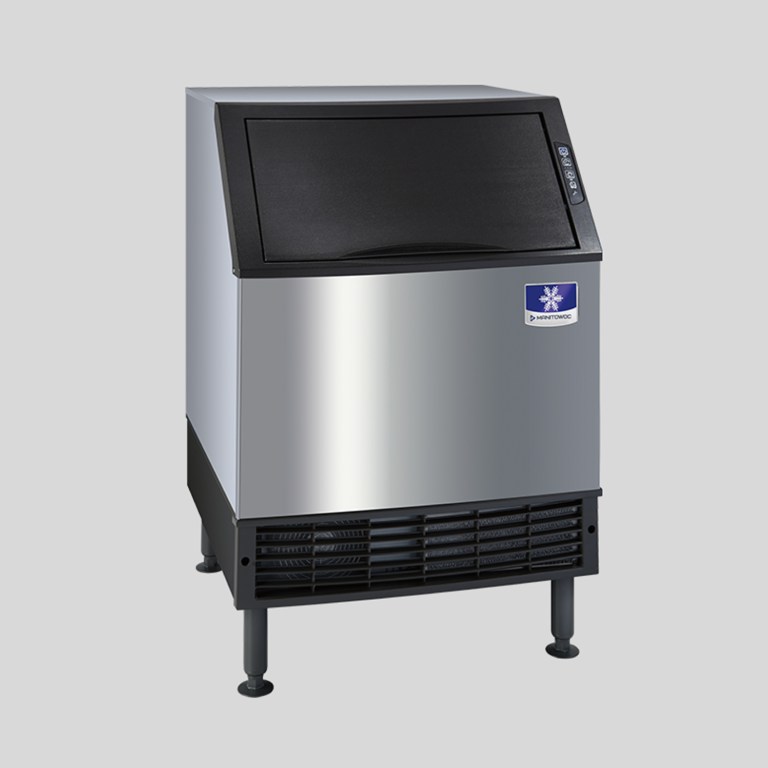
Undercounter ice machines hold the ice maker and storage bin in a single cabinet that fits beneath a standard counter. This design puts to work the space that would otherwise sit empty.
Output and storage are lower than in a modular setup, so this configuration works best for steady, moderate demand near where drinks are poured. A bar, for example, can keep ice within reach of the bartender. A hotel breakfast station can refill beverages throughout the morning without a trip to the kitchen.
2. Modular ice machines
- Best for: Hospitality and healthcare facilities with high daily ice demand
A modular commercial ice machine comes in two pieces: an ice maker head that sits on top of a separately sized bin or dispenser. Because the head is dedicated to making ice, modular units offer the highest output among all configurations.
A separate bin lets operators size storage around peak demand. That suits a fleet-based operation stocking up before a shift change or a hotel supplying ice stations across several floors.
Many modular heads are also available with a remote condenser, which moves heat and noise out of an environment that already runs hot. For high-volume sites with limited airflow, that pairing gives operators the most ice without adding heat to the workspace.
3. Ice baggers
- Best for: Warehouses and fleet-based operations that send ice off-site
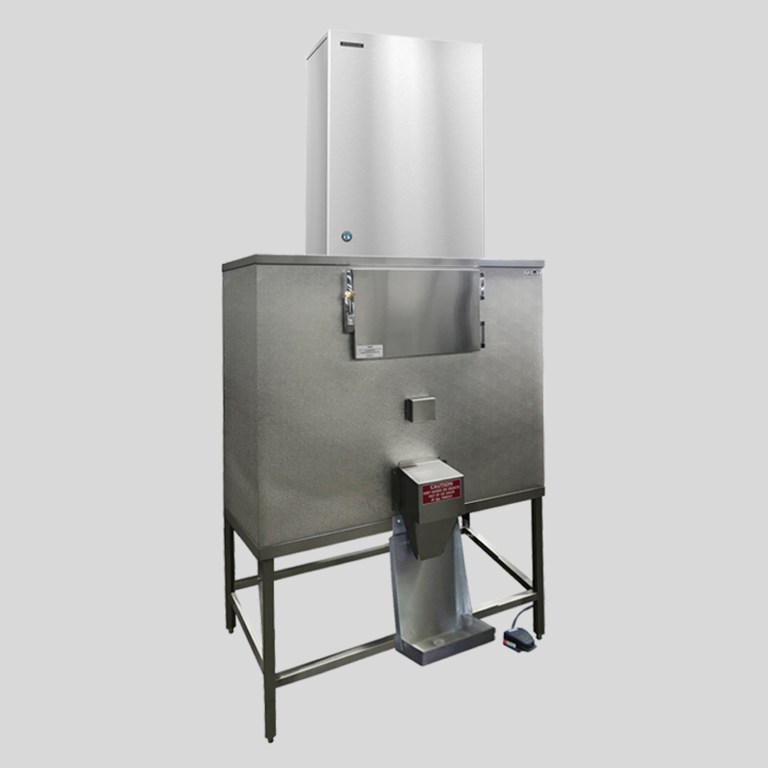
An ice bagger pairs an ice machine with a storage bin that fills bags on demand. On many models, staff press a button or foot pedal to fill a bag, so hands stay out of the stored ice.
Baggers make the most sense when ice needs to travel. Crews at manufacturing and warehouse sites can grab a bag for their coolers, and drivers at fleet-based operations can load up before heading out on routes. In healthcare settings, staff can fill bags with cold packs for patients without handling loose ice.
4. Freestanding ice and water dispensers
- Best for: Hotels and healthcare facilities with high-traffic shared spaces
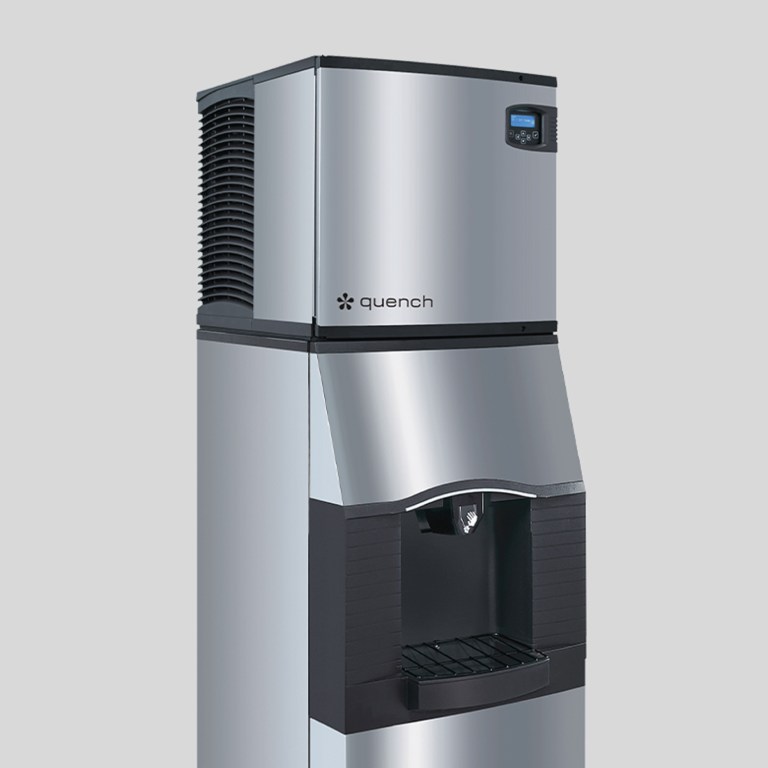
Freestanding ice and water dispensers work like countertop units but stand on the floor in their own cabinet. That extra height and footprint make room for more storage.
Hotels often place these units on guest floors and near lobbies, where guests serve themselves throughout the day. In healthcare, freestanding dispensers are a common fit for patient floors and staff break rooms that need a steady supply of ice and water in one place.
Types of ice and when to use them
Different types of ice machines produce different ice shapes and the shape affects both melt rate and where the ice works best.
Slow-melting cubes suit restaurants and bars that want less dilution in drinks. Nugget ice is soft and easy to chew, which makes the shape a common choice for office break rooms and healthcare settings where patients need gentler ice. Flake ice packs tightly around food, so seafood displays use flake to keep products cold. Here’s a closer look at each type.
| Ice type | Melt rate | Common uses |
| Full cube | Slowest | Bagged ice and mixed drinks |
| Half cube | Slow | Fountain drinks and dispensers |
| Crescent | Slow | Beverage dispensers and cocktails |
| Tulip | Moderate | Self-serve dispensers and blended drinks |
| Nugget | Fast | Healthcare settings and blended drinks |
| Flake | Fastest | Seafood displays and injury care |
How to size a commercial ice machine
Sizing a commercial ice machine involves considering production and storage capacities. Production capacity measures the amount of ice, in pounds, the machine produces in 24 hours. Storage capacity is the amount of ice the bin holds at one time.
To estimate daily ice needs, multiply the number of people or rooms your site serves by the figure that fits:
| Measured by | Ice per day |
| Patients | 10 lbs per patient |
| Rooms | 5 lbs per room |
| Employees | 2.5-5 lbs per employee |
| Customers | 1-3 lbs per customer |
| General occupancy | 1 lb per person |
Add about 20% to the daily estimate to cover busy days and future growth. Then use that total to find a matching Culligan Quench model:
| Daily ice needed | Culligan Quench models | Daily ice production | Ice storage |
| Up to 125 lbs | 956, 960/965, 978-H/979-H | 44-125 lbs | 7-13.2 lbs |
| 125-425 lbs | 960-16/965-16, 980-12, 980-30, 980-50 | 165-425 lbs | 12-50 lbs |
| 425+ lbs | 980-90, 905, 992, 994, 998, bagger series | 250-1,875 lbs | 90-900 lbs |
Air-cooled vs. water-cooled vs. remote condenser machines
Ice machines remove heat as they make ice and the cooling method determines where that heat goes.
- Air-cooled: A fan blows heat from the condenser into the room. These units need open space around the vents, so they work well in offices and break rooms.
- Water-cooled: Water carries heat away from the condenser, so these units use more water but less electricity. They need less clearance and suit tight spaces, though some local codes limit their use.
- Remote condenser: Refrigerant lines carry heat to a condenser on the roof or an exterior wall. These units keep heat and noise out of busy kitchens, making them a good fit for restaurants and hotels.
Since the best commercial ice maker for your site depends on where the unit will go, start by matching the cooling method to the space. Then browse Culligan Quench ice machines to compare air-cooled, water-cooled and remote condenser models.
Installation requirements
Most commercial ice machines connect directly to a building’s water line and need a nearby floor drain to carry away melted water. Larger models often require a dedicated electrical circuit, so check the spec sheet for voltage before choosing a location. Leave open space around the unit for airflow and service access.
You should also consider ambient temperature. Ice production drops as the room gets hotter, so keep air-cooled units away from ovens and fryers. Units in unheated spaces can also freeze in cold weather.
Culligan Quench handles installation with more than 500 service technicians stationed nationwide, so a trained technician manages the setup at each location.
Water filtration and maintenance
The water going into an ice machine directly affects the quality of the ice coming out. Minerals and chlorine in tap water can make ice cloudy or give drinks an off taste. Hard water causes a second problem as well. Over time, minerals leave scale, a chalky buildup, on internal parts, which slows ice production and makes the unit work harder. An inline filter on the water line helps control scale and reduce chlorine before the water reaches the machine.
Filtration cuts down on buildup, but regular cleaning is still part of ice machine upkeep. Cleaning schedules vary based on local water quality and the conditions around the unit, so check the manufacturer’s recommendations for your model. Storage bins should be emptied and cleaned on the same schedule as the machine.
Culligan Quench offers preventive maintenance for ice machines twice a year, which keeps upkeep on track without adding to your team’s workload.
Buying vs. renting a commercial ice machine
Purchase prices rise with capacity, from undercounter units and countertop dispensers at the lower end to modular setups and bagger systems at the top.
Owners also pay ongoing costs for filters, repairs, maintenance, water and electricity. ENERGY STAR-certified models help lower those costs. Certified batch-type ice makers are about 10% more energy-efficient and 20% more water-efficient than standard models, saving businesses around $150 a year.
Renting offers another path. Businesses pay a monthly fee instead of the full purchase price and the rental provider typically handles service and repairs. With Culligan Quench, preventive maintenance is included in the rental agreement. Here’s how the two options compare:
| Buying | Renting from Culligan Quench | |
| Upfront cost | Full purchase price | Monthly fee instead of a large purchase |
| Maintenance | Owner handles repairs and upkeep | Twice-yearly preventative maintenance included |
| Filters and repairs | Paid by the owner | Included in the monthly fee |
| Upgrade flexibility | Replace the unit or buy a second one | Change models as needs shift |
| Multi-site management | Separate vendors and schedules by location | One provider and consolidated billing |
Find the right ice machine for your workplace
The right commercial ice machine depends on how much ice your site uses and where the unit will go. Start there, and the machine type, cooling method and choice to buy or rent get much easier.
Browse Culligan Quench ice machines to compare models by capacity. Or get a free estimate, and our water experts will recommend the right fit for each location, with maintenance included.

Frequently asked questions
What is the best ice machine for a restaurant?
The best commercial ice maker for a restaurant depends on volume and kitchen space. High-volume kitchens do best with a machine that has a separate storage bin, and a remote condenser keeps heat and noise out of the kitchen. Smaller restaurants and bars can use an undercounter unit like the Culligan Quench 905, which makes 250 pounds of half-cube ice per day.
What size ice machine does an office need?
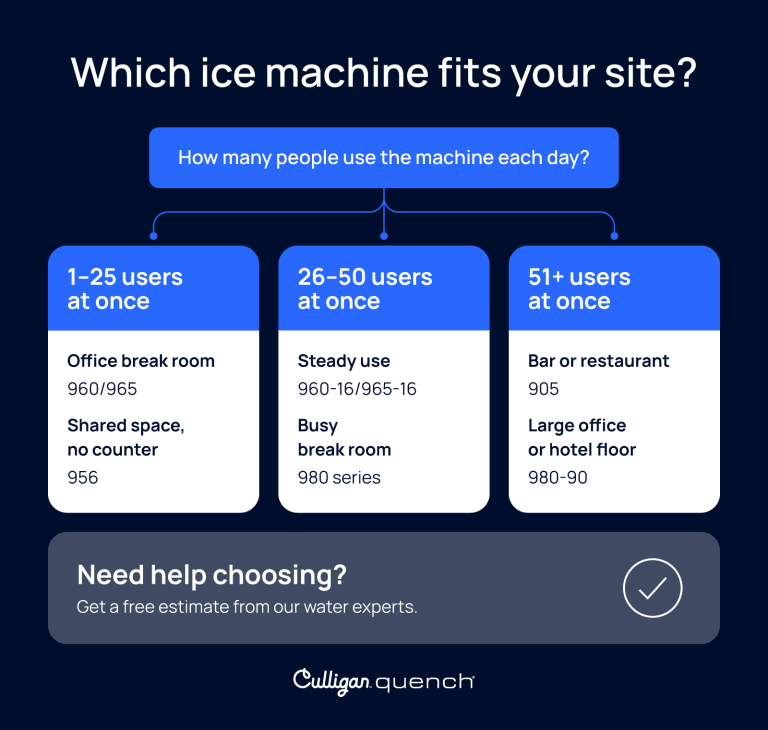
Office ice needs depend on headcount. Culligan Quench sizes machines by daily users. Models like the 960/965 cover offices with up to 25 people, the 980 series handles 26 to 50 and larger options like the 980-90 serve 51 or more. If your team spikes around lunch, build in extra capacity so the machine keeps up during peak hours.
Do you need a water filter for a commercial ice machine?
Yes, in most cases. A water filter reduces chlorine and helps control scale, which can cloud ice, affect taste and slow production over time. Filtering the water before it reaches the machine also reduces repairs and keeps the unit running efficiently.
What's included when you rent a commercial ice machine?
Rental terms vary by provider. With Culligan Quench, the monthly fee covers preventative maintenance. Our service technicians perform preventive maintenance twice a year and handle repairs as needed. Multi-site businesses can also manage all locations under a single agreement with consolidated billing.
Does an ice machine need a drain?
Most commercial ice machines need a drain. Melt water from the storage bin and water flushed out during each ice-making cycle have to go somewhere, usually a nearby floor drain. Some smaller countertop units drain into a built-in tray or a drain line, so check the spec sheet before choosing a location. Culligan Quench technicians will confirm access to the drain during installation.
How long does a commercial ice machine last?
The U.S. Department of Energy estimates that commercial ice machines last about 8.5 years on average, or 7.5 years for low-capacity models. Water quality and maintenance play a big role. Scale buildup is a common cause of early wear, so filtered water and regular cleaning help machines last longer. Culligan Quench rentals include twice-yearly preventive maintenance and repairs.