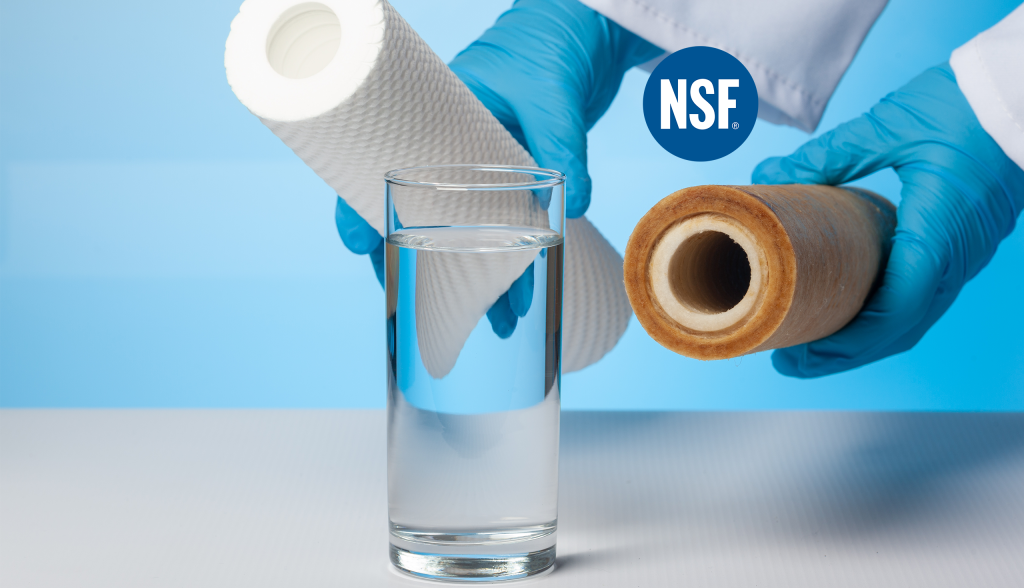
What Do NSF Certifications Mean for Water Filters?

Summary: NSF certifications provide independent verification that water filtration systems meet recognized safety, material and performance standards. Understanding standards like NSF/ANSI 42, 53, 58, 61 and 372 helps buyers confirm a system improves water quality, uses safe materials and performs as claimed.
If you’re responsible for water quality in your workplace, you don’t just need a system that looks good. You need one that stands up to safety standards, compliance requirements and employee expectations. NSF certifications are one of the quickest ways to validate what a filtration system is designed to do.
Knowing these certifications can help you choose a system you can trust for your employees, your workplace, and your peace of mind.
| Standard | Description |
| NSF/ANSI 42: | Improves taste and odor (aesthetic effects), often reduces chlorine |
| NSF/ANSI 53: | Reduces health-related contaminants (varies by filter), such as lead |
| NSF/ANSI 58: | Verifies that a reverse osmosis system meets requirements for safety, construction and performance |
| NSF/ANSI 372: | Verifies low lead content in materials and components |
| NSF/ANSI 61: | Ensures materials are safe for contact with drinking water |
Why water treatment device certifications matter
It’s often assumed that NSF certifications only apply to replaceable filter cartridges. In reality, these standards can apply to the full water treatment device too, including bottleless coolers, dispensers, connected plumbing components, fittings and any wetted parts that come in contact with drinking water. That matters in workplaces because you’re choosing a system that has to deliver safe, consistent water day after day, often under compliance requirements.
It’s also worth clearing up one of the biggest sources of confusion: a product can be certified to an NSF standard without showing an NSF logo on the unit or label.
Here’s the simple translation of what you may see:
- The NSF standard is the rulebook. Standards like NSF/ANSI 42, 53, 61 and 372 define the health, safety and performance requirements a product must meet.
- An NRTL is an independent referee. An NRTL (Nationally Recognized Testing Laboratory) is a third-party organization accredited by OSHA to test products and certify that they meet specific standards.
- The logo is the referee’s “stamp,” not the rulebook. On a system data label or filter label, you may see language like “certified to NSF/ANSI 42” alongside an IAPMO R&T Shield (or another NRTL mark). That mark indicates which accredited organization verified compliance to the standard.
Here is an example of a data label from Culligan Quench. Note the certification verbiage and the IAPMO R&T logo.
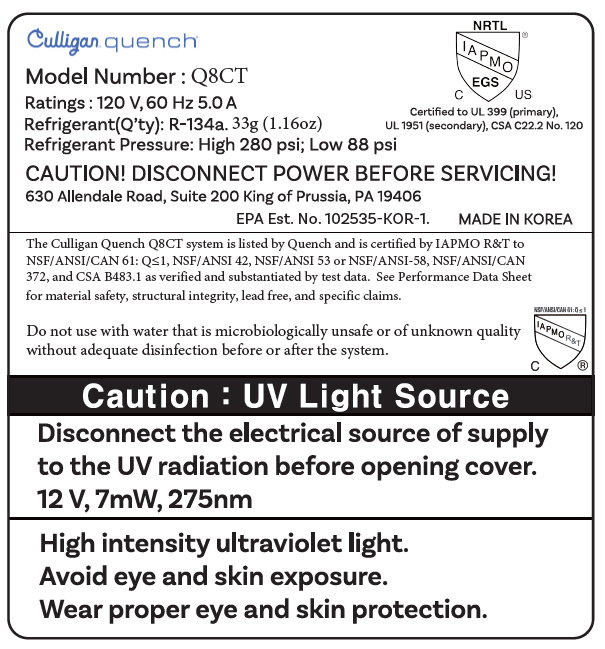
For buyers, the takeaway is simple: when reviewing spec sheets or labels, look for both the NSF standard(s) a product meets and the certifying body’s mark. This ensures real performance, helps separate fact from marketing claims, and provides the documentation you need for audits, reviews, or facility requirements.
NSF/ANSI 372: Lead-free certification
NSF/ANSI 372 (Drinking Water System Components – Lead Content) verifies that materials and components in a drinking water system meet the federal “low-lead” requirement, based on a weighted average lead content of 0.25% or less. In the United States, that low-lead threshold is a federal requirement that was amended into the Safe Drinking Water Act and took effect in January 2014, enforced by the U.S. Environmental Protection Agency (EPA).
Schools, health care facilities and offices in older buildings need to prioritize this standard to make sure the hardware doesn’t become a source of contamination. NSF 372 strictly covers the material composition of the hardware, distinguishing it from filters designed to remove lead from the water stream. A system can be certified lead-free in construction while requiring a separate mechanism to filter out incoming lead from the municipal supply. Getting the lead out effectively usually requires paying attention to both the hardware material and the filter capability.
NSF/ANSI 61: Drinking water system components
NSF/ANSI 61 confirms that drinking water system components like pipes, gaskets, tanks, valves, fittings and faucets do not leach harmful contaminants into the water they carry. Because water can interact with the materials it touches over time, especially in systems with storage tanks or complex internal pathways, components must be evaluated to ensure they do not introduce unwanted substances into the water. Testing for this certification assesses a multitude of potential contaminants, with requirements tailored to the material type, exposure conditions and the toxicology review category for the product.
For bottleless coolers and point-of-use dispensers, NSF/ANSI 61 compliance provides assurance that the drinking water delivered at the point of use is filtered after moving through internal tubing and components, including guarding against contaminants such as lead that could be imparted by the system before the water reaches your glass. Advanced filtration technology builds on this baseline by addressing the specific contaminants you’re trying to reduce, while NSF/ANSI 61 helps ensure the system itself isn’t adding anything back in along the way.
NSF/ANSI 42: Drinking water treatment units – Aesthetic effects
NSF/ANSI 42 covers the material safety of components in contact with the drinking water, and the structural integrity of those components to verify they will not leak under pressure. The NSF/ANSI 42 Standard also covers the reduction of aesthetic impurities that affect how water tastes and smells.
Municipal water treatment plants often use chlorine to kill bacteria, which leaves a distinct chemical aftertaste and odor that many people find unpalatable. Filters with this certification—typically carbon block or granular activated carbon—adsorb these chemicals to produce crisp, refreshing water.
Offices and hospitality venues prioritize this standard because better-tasting water encourages hydration. High-quality water also improves the flavor profile of office perks, such as coffee, tea and fruit-infused water. While NSF/ANSI 42 is commonly associated with aesthetic improvements, it also includes requirements tied to safe materials and reliable performance under pressure, helping confirm the unit is built to operate safely as part of a drinking water treatment system.
Case study: Convenient Hydration Service for Road Runner Sports
Learn how Culligan Quench provided an NSF-certified, cost-effective water solutions for a retail chain with locations across the U.S.
Download for freeNSF/ANSI 53: Drinking water treatment units – Health effects
NSF/ANSI 53 stands as one of the primary filtration benchmarks for reducing contaminants with known health effects. An NSF 53 water filter has passed rigorous testing to verify it removes harmful substances, such as lead, Cryptosporidium cysts, asbestos, volatile organic compounds (VOCs) and certain PFAS (forever chemicals). That distinction places it in a different category than filters solely designed for taste improvement.
Health care environments and schools rely on this standard to address documented water quality risks. Specialty water filters that carry the NSF 53 water filter mark offer a verified defense against invisible threats that aesthetic filters might miss. You’ll often see filters that carry both NSF 42 and NSF 53 certifications, providing a comprehensive solution that addresses both the safety and the enjoyment of the water.
NSF/ANSI 58: Reverse osmosis drinking water treatment systems
NSF/ANSI 58 applies specifically to reverse osmosis (RO) drinking water treatment systems. It is designed to verify that an RO system performs as expected under defined test conditions, including requirements tied to system performance and contaminant reduction claims (which can vary by the exact system and configuration). Because RO is a distinct treatment approach, NSF/ANSI 58 is an important standard for buyers who want third-party verification that an RO system is doing what it claims, not just filtering for taste.
For workplaces considering RO for higher confidence in their water quality, NSF/ANSI 58 certification can be a meaningful differentiator. It shows the system has been independently evaluated against a standard built for RO technology, with verified performance claims tied to that category.
How certifications influence purchasing and compliance
Certification requirements frequently dictate which systems a business can legally or operationally install. Procurement teams in government or institutional settings often list NSF standards as non-negotiable line items in Request for Proposals (RFPs). A system might function perfectly well mechanically, but without the proper certification, it could fail a building inspection or disqualify a facility from green building credits.
Buyers must review spec sheets carefully to match the certification to the specific problem they need to solve. Dealing with known contaminants requires a different verification than simply improving the taste of tap water. Culligan Quench acts as a strategic partner in this process, helping you navigate the technical data to find the equipment that aligns with your internal safety mandates and external regulatory obligations. There are many reasons to trust Culligan Quench with this selection, primarily our ability to match specs to your unique environment.
Know what you’re buying: Certifications that actually matter
Water safety requires evidence rather than assumptions. Certifications like NSF 372, 61, 42, 53 and 58 provide the data you need to confirm that a system is built safely, uses safe materials and effectively removes the contaminants it claims to target. Understanding these certifications helps you select equipment that protects your employees, meets facility requirements, and supports long-term operational reliability.
Knowing these definitions empowers you to make an investment that protects your people and your bottom line. We can help you assess your current water quality needs and match them to a certified reverse osmosis or filtration system that fits your facility.
Ready to secure a certified water solution for your workplace? Contact Culligan Quench today to speak with a water expert.

NSF certifications help buyers quickly verify the safety and performance of drinking water systems.
- Independent Verification: NSF standards provide third-party validation that a system meets established health, safety and performance requirements.
- Trusted Certification Standards: Certifications such as NSF/ANSI 42, 53, 58, 61 and 372 confirm key capabilities like taste and odor improvement, contaminant reduction, reverse osmosis performance and low-lead materials.
- Whole-System Safety: These standards can apply not just to filters, but also to dispensers, plumbing connections and other components that come into contact with drinking water.
- Clear Labeling Matters: Products may display the NSF standard alongside a certification mark from an accredited testing laboratory (NRTL), confirming independent compliance.
- Confidence for Compliance: Reviewing certification standards and testing marks helps organizations meet facility requirements, pass audits and confidently select systems that protect employees.
Recommended Products
Q14 Bottleless Water Cooler
Available with quenchWATER+ electrolyte water
 Commercial
 Hot
Hot
 Cold
Cold
 Ambient
 Extra Hot
 Sparkling
Top pick
Sparkling
Top pick
Q12 Touchless Bottleless Water Cooler
Available with quenchWATER+ electrolyte water
Commercial
Hot
Cold
Ambient
Extra Hot
Sparkling
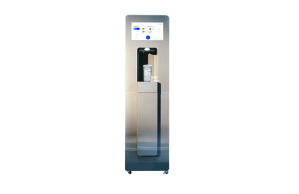
Twist Flavored and Sparkling Water Dispenser
Commercial
Hot
Cold
Ambient
 Flavored
Sparkling
Risk-free trial
Flavored
Sparkling
Risk-free trial